"Blueprint" is the title of the controversial book of Robert Plomin explaining in detail the results of their studies with cufflinks Identical siblings for more than ten years - Identical siblings in their genetic sequence...happens in 30/1000 births.
The reason these are such important studies is because allow you to “isolate” the environment variable and whose impact on certain traits is considered to be the main variable. We are referring to the fundamentally psychological characteristics that have become the recent field of study of "behavioral genetics" or behavioral genetics and that offer solid results. According to the study, identical twins have 55% more similarity in verbal ability than siblings. twins32% more in spatial capacity, 62% more in processing speed and 52% more in memory -> Genetics plays a fundamental role.
The book is aimed at the general public and great previous knowledge about genetics is not necessary, but a certain capacity for mathematical comprehension is necessary to understand the fundamental concept of the book; the importance of our genes in our "personality" and the key concept of "Heritability"
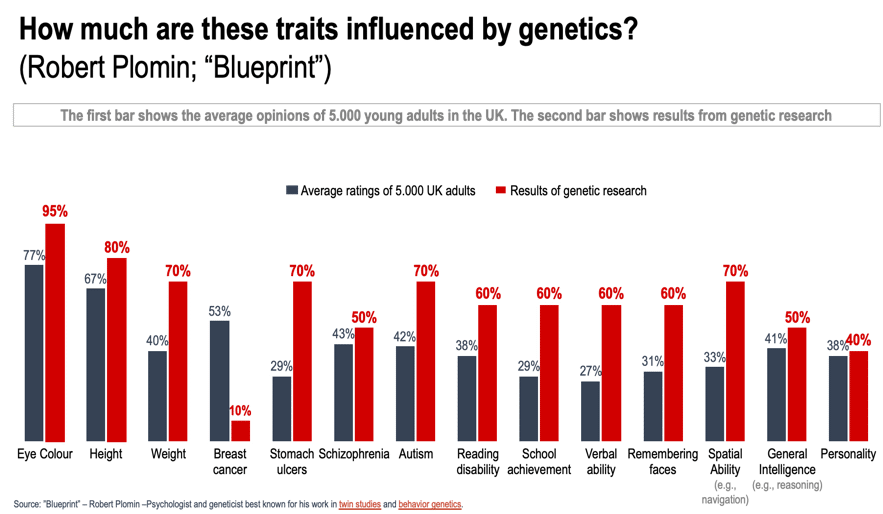
So that you you can get an idea, then we leave you with a graph that explains the % of heritability for different traits - compared to what 5000 Brits think about it. The conclusion is clear, we tend to think that the influence of genes is less in most of the traits, only when they are diseases (breast cancer) do we think they have a greater influence (and it is just the opposite) - Now, To understand this graph, it is important to explain the concept of heritability.
Heritability is a measure of how well differences in people's genes explain differences in their traits. Traits can include characteristics such as height, eye color, and the intelligence, as well as disorders such as schizophrenia and spectrum disorder autistic. In scientific terms, heritability is a statistical concept (represented as h2) that describes how much of the variation in a given trait can be attributed to genetic variation. An estimate of the heritability of a trait is specific to a population in an environment, and can change over time as circumstances change.
Heritability estimates range from zero to one. Heritability close to zero indicates that almost all variability in a trait between people is due to environmental factors, with very little influence from genetic differences. Traits such as religion, spoken language, and political preference have zero heritability because they are not under genetic control. Heritability close to one indicates that almost all variability in a trait comes from genetic differences, with very little contribution from environmental factors.
Heritability has historically been estimated from twin studies. LIdentical twins have almost no differences in their DNAwhile fraternal twins share, on average, 50 percent of their DNA. If a trait appears to be more similar in identical twins than in fraternal twins (when they were raised together in the same environment), genetic factors likely play a role in determining that trait. By comparing a trait in identical twins versus fraternal twins, researchers can calculate an estimate of its heritability.
Heritability can be difficult to understand, so there are many misconceptions about what it can and cannot tell us about a given trait - The most common and important mistake to clarify is:
Heritability it does not indicate what proportion of a trait is determined by genes and what proportion is determined by the environment. Therefore, a heritability of 0.7 does not mean that a trait is 70% caused by genetic factors; means that the 70% of variability in the trait in a population is due to genetic differences between people.
In ADNTROwe have replicated the result of these studies in our own DNA testing to predict their personality in different dimensions. Some of these variables have a high statistical relevance (such as Introverts vs. Extroverts), and others have a lower relevance.
It is important to clarify that with this information only a genetic predisposition can be predicted, and not capture the complexity involved in the meaning of the word “personality”; but this is precisely the most beautiful angle in genetics - a horizon to explore - En ADNTRO we have developed an algorithm (In short, and not to pretend to appear unnecessary complexity, an algorithm is nothing more than a mathematical operation) that, using the personality of the founding team itself, as well as the different participants and the markers identified in Robert Plomin's studies , allows to obtain a more or less accurate classification, called MBTI for its acronym in English (Myers briggs) - You can do the "real" test, for free, and check your results and help us improve ADNTRO of the algorithm.
At ADNTRO, we close 2025 with the satisfaction of a year full of advances and discoveries. We have evolved with you, creating more comprehensive reports and functionalities that
If you have taken a test with 23andMe, MyHeritage, Ancestry.com and others, you can upload your DNA for free at 23andMe, MyHeritage, Ancestry.com and others.
For digestive clinics or physicians. Provides information on the genetic predisposition to develop diseases of the digestive system- such as Chron's, Inflammatory Bowel Disease among many others - as well as intolerances. This supports a possible early diagnosis and prevention. The results of this study are very positive, allowing for more precise and personalized interventions to improve the quality of life of the patients.
Cardio
The applicability and importance of the PRSs in cardio is endorsed by the American Heart Association (AHA). The applicability of PRS is made possible thanks to this tool that helps in the cardiovascular disease prevention: identifying patients with a higher genetic risk of developing conditions such as diabetes, thromboembolism, hypercholesterolemia, and coronary artery disease (CAD), among others, enabling early interventions and preventive measures to improve patients' cardiovascular health.
Biobanks, Pharmacies and CROs
Access and consultation of genetic data relevant to health and pharmacology. Thanks to this tool, it is possible to know the predisposition of patients to suffer adverse effects and what dose adjustments are necessary for more than 150 drugs, thus improving safety, efficacy and treatment personalization. This information is backed by Stanford University and approved by the FDA and gives solutions for biobanks, and research organizations.
Dermatology
Specialized for dermatological clinics, this service provides information on dermatogenomics: skin sensitivities, efficacy of various topical and oral treatments, essential vitamins and minerals for skin health, dermatological conditions, skin types and more data to help you customize your skin care recommendations.
Fitness and wellness centers
Genetic analysis allows for the design of personalized training programs that, taking into account genetic characteristics focused on the world of sports, such as muscle fiber types and predisposition to injuries, maximize performance and reduce the risk of injuries. Additionally, by considering genetic factors related to sleep and longevity, recommendations can be offered for a healthy and sustainable lifestyle.
Nutri & Fitness
The practical application of nutrigenomics allows you to differentiate yourself from the competition by offering your patients personalized and accurate information on genetic predispositions to food intolerances.The results of this approach allow the design of dietary plans completely adapted to the genetic profile of the patient. This approach makes it possible to design dietary plans completely adapted to the individual needs maximizing results and providing an exceptional and differentiated service in the field of nutrition.
Very useful for psychiatric clinics and psychological clinics. Provides information on the genetic predisposition to develop nervous system diseases and mental disorders, such as Alzheimer's, Parkinson's, schizophrenia, bipolar disorder and OCD, among others. This supports a possible early diagnosis and prevention of these conditions, allowing for more precise and personalized interventions for improve the quality of life of patients.
Start a unique journey inside your DNA
Kind regards from ADNTRO team
Guillermo Pérez-Solero Monzon
Behavioural Genetics
How much does genetics influence behavior?
To what degree do genetics influence behavior? Robert Plomin explains in detail the results of his studies with identical twins.
El CEO de ADNTRO Genetics, reconocido por su enfoque disruptivo e innovador en biotecnología, fundó ADNTRO con el objetivo de democratizar el acceso a la información genética. Gracias a la inteligencia artificial y algoritmos avanzados, ha logrado avances significativos en el análisis del ADN, proporcionando valiosas perspectivas sobre predisposiciones genéticas y susceptibilidades a diversas enfermedades. Guillermo, también cuenta con una gran trayectoria en Bain & Company, donde desarrolló habilidades estratégicas en diversos sectores a nivel internacional. Su combinación de conocimientos técnicos en genómica y habilidades estratégicas en consultoría, ha posicionado a ADNTRO como líder innovador en genética. Su liderazgo y enfoque visionario hacen de él un referente en el panorama de los empresarios disruptivos.