
Diabetes is considered one of the most common leading causes of disease, disability and death worldwide. According to estimates of the International Diabetes Federation (IDF) affects approximately 537 million people worldwide.

What exactly is diabetes and what causes it? Is diabetes hereditary? Of the different types of diabetes that exist, which diabetes is hereditary? Let's start by the beginning.
What is diabetes?
Diabetes is a chronic disease that affects the way the body regulates the level of sugar (glucose) in the blood. Glucose is an important source of energy for the body, and its proper level is crucial for the normal functioning of tissues and organs.
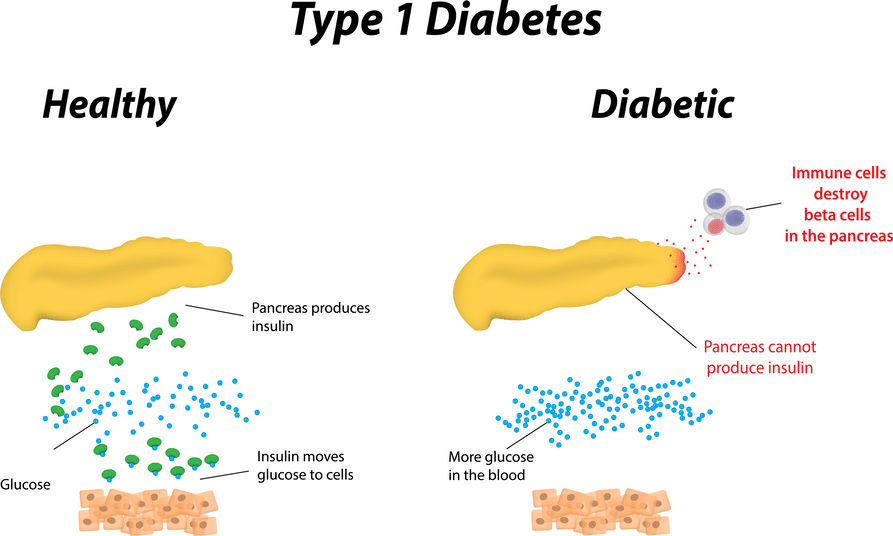
Diabetes occurs when the body doesn't make enough insulin (a hormone produced by the pancreas) or when it can't use it effectively. Insulin is necessary for glucose to enter into the cells and be used as energy. When there is a lack of insulin or its action is inadequate, glucose builds up in the blood, leading to elevated blood sugar levels, known as hyperglycemia.
Diabetes can have long-term complications if it is not properly controlled. These can include heart disease, stroke, kidney problems, nerve damage, eye problems, and foot problems. Diabetes management involves maintaining adequate blood sugar through a combination of medications, healthy eating, physical activity, and regular monitoring of glucose levels.
Types of diabetes
Depending on cause and pathophysiological mechanisms that characterize diabetes can be classified into different types. In this section you can learn about the most important characteristics of each of them. If you would like to learn more about how glucose is regulated in metabolic terms, you can do so in our article "types of diabetes".
Type 1 diabetes
In this type of diabetes, the body's immune system attacks and destroys insulin-producing cells in the pancreas (autoimmune disease). As a result, the body produces little or no insulin. Type 1 diabetes is usually diagnosed in childhood or adolescence, and people with this disease require daily insulin injections to survive.
Type 2 diabetes
It is the most common type of diabetes. In type 2 diabetes, the body does not use insulin efficiently. It is often associated with overweight, obesity and lack of physical activity. It has been shown that a good diet and a healthy lifestyle can control this pathology. However, sometimes it is necessary to resort to oral medications or insulin injections.
Gestational diabetes
It occurs during pregnancy and usually goes away after the birth of the baby. However, women who have had gestational diabetes have a higher risk of developing type 2 diabetes in the future.
Which diabetes is hereditary?
The three types of diabetes mentioned above have a genetic predisposition (heritability), which means that there is a hereditary influence on the development of the disease. Within the different types of diabetes, type 2 diabetes has a higher percentage of heritability (40-70%), followed by type 1 diabetes (50%). In third place, gestational diabetes is placed although there is no clearly established percentage.
However, it is important to note that genetics is not the only factor that determines whether or not a person will develop diabetes.
In the case of type 1 diabetes, there is a genetic predisposition, but interaction with environmental triggers is also required for the disease to develop such as infection from some viruses that triggers the autoimmune response.
When we talk about type 2 diabetes, there is also a genetic influence, but the development of the disease is strongly related to environmental factors such as diet and lifestyle.

At ADNTRO we continue to investigate: our own predictive model for Type 1 Diabetes
At ADNTRO, we not only analyze your DNA, but we also regularly update the studies we rely on to ensure the results you receive are increasingly accurate. One of the most significant advances in our analysis of genetic protection or predisposition to [unclear - possibly "a specific disease" or "a specific disease"] is the [unclear - possibly "a disease" or "a disease"]. Type 1 Diabetes (T1D) It has been the incorporation of a proprietary model developed from genetic data of 11,909 individuals from the UK Biobank (public database with genetic and clinical information).
This model replaces traditional linear approaches with a neural network capable of detecting complex patterns among genetic variants that classical methods fail to capture. The result is an accuracy (AUC) of 88,89%, compared to the 71.6% of the previous model, a significant qualitative leap in predictive capacity.
Among the scientific innovations it incorporates, the use of the Shannon entropy to measure the degree of genetic variability within the individual profile. Risk is further classified into 5 levels —from "very low" to "very high"— to facilitate a clearer and more useful interpretation.
This work has been published in the journal International Journal of Molecular Sciences under the title Enhancing Type 1 Diabetes Polygenic Risk Prediction Through Neural Networks and Entropy-Derived InsightsThis confirms the strength of the method we use on our platform.
If you already have your ADNTRO genetic test, you can check the results on the platform. And if you haven't had it yet, now is a great time to learn what your DNA can tell you about yourself.
Discover with the genetic test from ADNTRO your genetic predisposition to type 1 diabetes and type 2 diabetes. It's very simple! And if you've already genotyped with another company, remember that you can upload your RAW DNA data for free.