
Where to upload your DNA: the best sites for your RAW file
We compare the main sites for uploading your DNA file in 2026 —ADNTRO, Genomelink, DNAGENICS, GEDmatch, Genetic Genie and Promethease— with verified prices, the formats they accept, the reports they include and how much you can get out of each one.

If you have already taken a test with 23andMe, MyHeritage, AncestryDNA or another genetic testing provider, your RAW file can give you much more than you saw on their website, without buying another kit or sending another sample. In this article we compare the best sites for uploading your DNA and what you get from each one.
Every price and feature in this comparison was verified on each company’s own website in November 2026.
Comparison table of sites for uploading your DNA (2026)
| ADNTRO | Genomelink | DNAGENICS | GEDmatch | Genetic Genie | Promethease | |
|---|---|---|---|---|---|---|
| RAW upload price | Free (ancestry composition) Basic €39 Premium €49 | Free · reports $24–69 | Free · packs €58.50 – €84.50 | Free · $10/month | Free | $25 |
| Accepts whole genome (VCF) | Yes | Yes | Converted to RAW — €19.50 | No | Yes | Yes |
| Ancestry | Yes | Yes | Yes | Yes | No | No |
| Haplogroups | Yes | Yes | Yes | No | No | Partial |
| Health research | Yes | No | No | No | Methylation and detox | Uninterpreted |
| Updates | 3 months free + €25/year or €120 for life | Subscription $14/month | Free with the packs | No | No | No |
| Where the company is | Spain | US | Spain | US | US | Israel |
Below you will find the detail on each one, plus two sections covering what this table cannot summarise: how much you really get out of your file on each site and what to check before uploading your DNA anywhere.
What a RAW genetic file is and how it works
The RAW file (or “raw data”) is what your company’s lab read in your DNA. In a genotyping test it is a text file with one line for every SNP analysed: its identifier, its position and the two letters you have there. There are usually between 600,000 and 700,000 positions.
Every company in this comparison works from that same file, but each one reads it in its own way. Each site matches it against its own database of studies and reference populations, which is why the same file gives different reports depending on where you upload it. You notice this most with ancestry: the number of reference populations and the model each site uses change the breakdown you are shown.
It works the same way on all of them:
- You download your file from your account with your original company. Each one calls it something different (“raw data”, “download DNA”, “download raw data”).
- You upload it as it is, without unzipping or editing it. Most accept .txt, .csv and .zip.
- The site processes it and shows you its reports, free or after paying, depending on the service.
ADNTRO

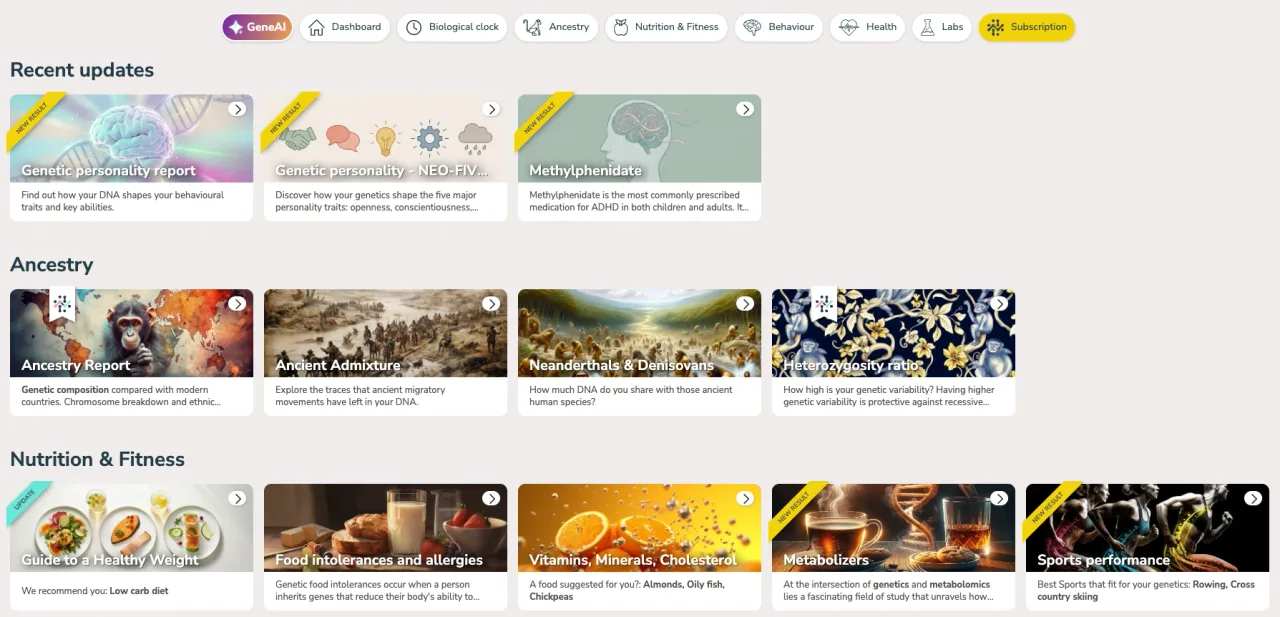
ADNTRO is a Spanish company founded in 2020 that accepts files from 23andMe, AncestryDNA, MyHeritage, FamilyTreeDNA, tellmeGen and other companies, as well as the VCF of a whole genome sequenced by another company.
Upload your file here: the ancestry composition is free and you get your results in under 24 hours. And with a single €49 payment you unlock every report.
Ancestry:
- Discover your ancestry: which of the 42 ethnic groups ADNTRO analyses your DNA most resembles, and in what proportion.
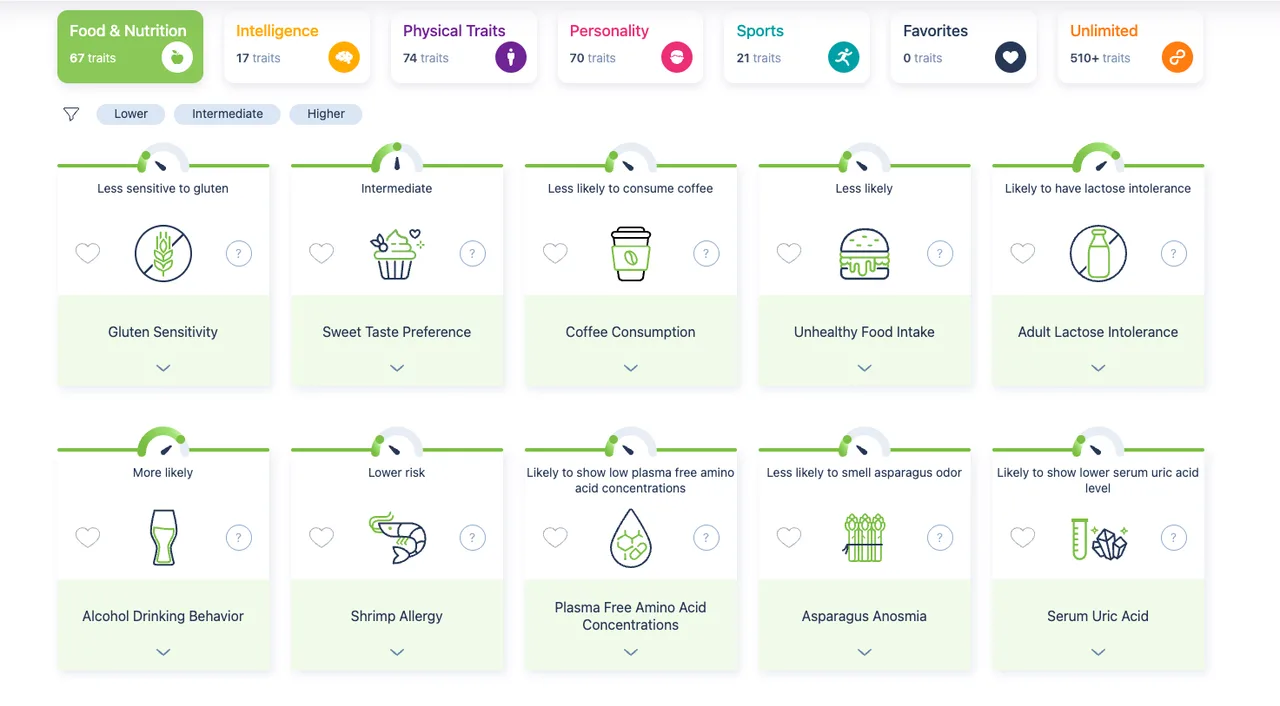
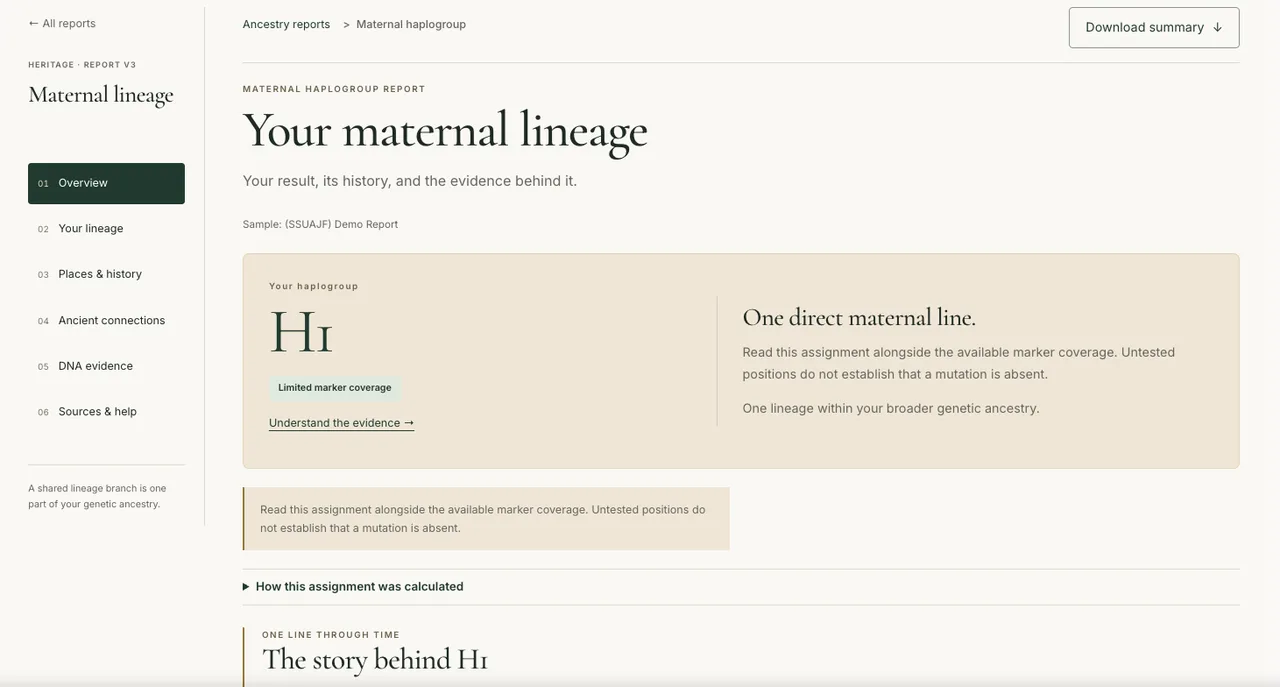
- Maternal and paternal haplogroups: who each of your two lineages descends from and where it is common. Each haplogroup can only be calculated if your file contains the markers for that lineage. MyHeritage files, for example, do not usually include the markers for the maternal haplogroup, so that result cannot be shown to you: your file does not have that information.
- Ancestral patterns: the traces of ancient migrations in your DNA, using the ADMIXTURE model, in collaboration with Professor Joshua Banta (University of Texas at Tyler).
- Neanderthal and Denisovan: how much you inherited from these two species.
- Genetic diversity: your variability compared with 26 populations from the 1000 Genomes project.
- Chromosome view: which stretches of your genome each origin sits in.
And with the same file:
- Nutrition: lactose, gluten, caffeine, fats and vitamin absorption, including food intolerances.
- Fitness: strength or endurance profile, recovery and injury risk.
- Longevity: genetic traits linked to ageing.
- Personality: genetic personality (Big Five model and MBTI), addictions, hormones, risk-taking, genetic abilities and warrior vs worrier.
- Health research tools and medication: predispositions backed by more than 300 GWAS studies, and how you process certain drugs.
- GeneAI, with the subscription: an artificial intelligence assistant you can ask questions about your results.
In total, more than 300 reports, and every result links to the publication it is based on, with the markers detected in your file.
Prices:
- Ancestry composition — free, no card needed. Results in under 24 hours.
- Basic — €39: every ancestry report, plus nutrition, fitness and longevity.
- Premium — €49, a single payment that unlocks everything: ancestry, nutrition, fitness, longevity, personality, and health and medication research tools.
- Updates — 3 months included; after that, €25 a year, or a lifetime subscription for €120.
- Whole genome upload (VCF) — €99.
Your data: processed on European Google Cloud servers, under the GDPR. ADNTRO does not sell or share your data, and you can download or delete it whenever you want.
The best site for uploading your DNA if you want the most complete option, whether you have the RAW file from a genotyping test or the VCF of a whole genome: ancestry, haplogroups, nutrition, fitness, personality and health and medication research tools in one place, with every result explained and its study linked.
Genomelink

Genomelink is an American company (Genomelink, Inc.). It does not sell kits: it only works with genetic files from other companies, including the VCF of a whole genome (in the GRCh37 build).
Available reports: ancestry across more than 160 ethnicities, maternal and paternal lineages, ancient DNA and a catalogue of more than 400 traits covering nutrition, fitness, personality, wellness and physical characteristics.
Prices: 100 free traits with no card needed. Beyond that, individual reports from $24 to $69 or a $14-a-month subscription that gives access to every trait and adds a new one each week. The whole genome has no separate price: you pay the same for each report.
What to know about its trait catalogue
Genomelink makes a point of how many traits it has, and adds a new one every week for subscribers. Among them are reports such as earwax type, marital satisfaction, seasonal mood changes or susceptibility to the framing effect, and others such as facial attractiveness, breast size or cellulite.
Some are curiosities with a clear genetic basis. Others are traits so complex that a genetic estimate can say little about any one person. Its ancestry section is more thorough, but overall what you pay for each month is, above all, entertainment.
Before paying, check which study each report is based on and which population it was carried out in.
A good option if you want lots of reports about yourself as entertainment. Bear in mind that everything new comes with the subscription, which renews every month.
DNAGENICS

DNAGENICS (DNA Genics, S.L.) is a Spanish company focused on deep ancestry. It accepts files from ADNTRO, 23andMe, AncestryDNA, MyHeritage and more than 30 other providers.
Available reports: more than 500 ancestry reports, ancient DNA matches, haplogroups and tools to compare your affinity with historical populations. It also sells packs that add personal traits.
Prices: the upload is free, and reports are bought individually or in one-off packs: the Starter Pack costs €58.50 and the Ultimate Pack €84.50, each for one sample.
If you have a whole genome: you cannot upload it directly. DNAGENICS only analyses .txt, .csv or .zip files, so first you have to run your VCF through its converter, which turns it into a genotyping file and costs €19.50. That is why most of your genome is left out of its reports: it only analyses the positions a chip would read.
A good option if deep ancestry is your passion and you enjoy comparing models.
GEDmatch

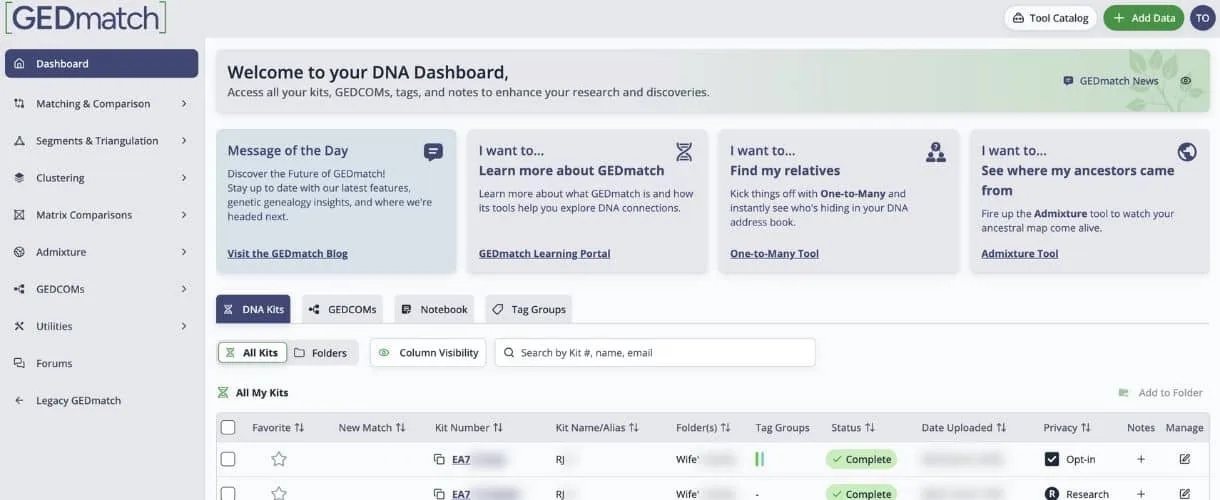
GEDmatch is the largest cross-company database for genetic genealogy: it compares your file with those of people who tested with other companies to find relatives.
Available reports: DNA matches, one-to-one comparison, shared segment analysis and admixture calculators with different population models.
Your file: it only accepts genotyping files. It does not accept the VCF of a whole genome.
Prices: the basic tools are free, up to a maximum of 5 kits per account. The advanced ones are in Tier 1: $10 a month with automatic renewal, $15 for a single month or $100 a year.
Bear in mind: to get the most out of it you will have to handle concepts such as shared segments or centimorgans, and its ancestry calculators give you figures without explaining them. Also review its privacy settings before uploading anything: your file is visible for matches with other users.
A good option if you want to complete your family tree or enjoy comparing ancestry calculators.
Genetic Genie

Genetic Genie is a free, donation-funded site run by the American company Genetic Genie LLC, designed for exploring specific variants in your file.
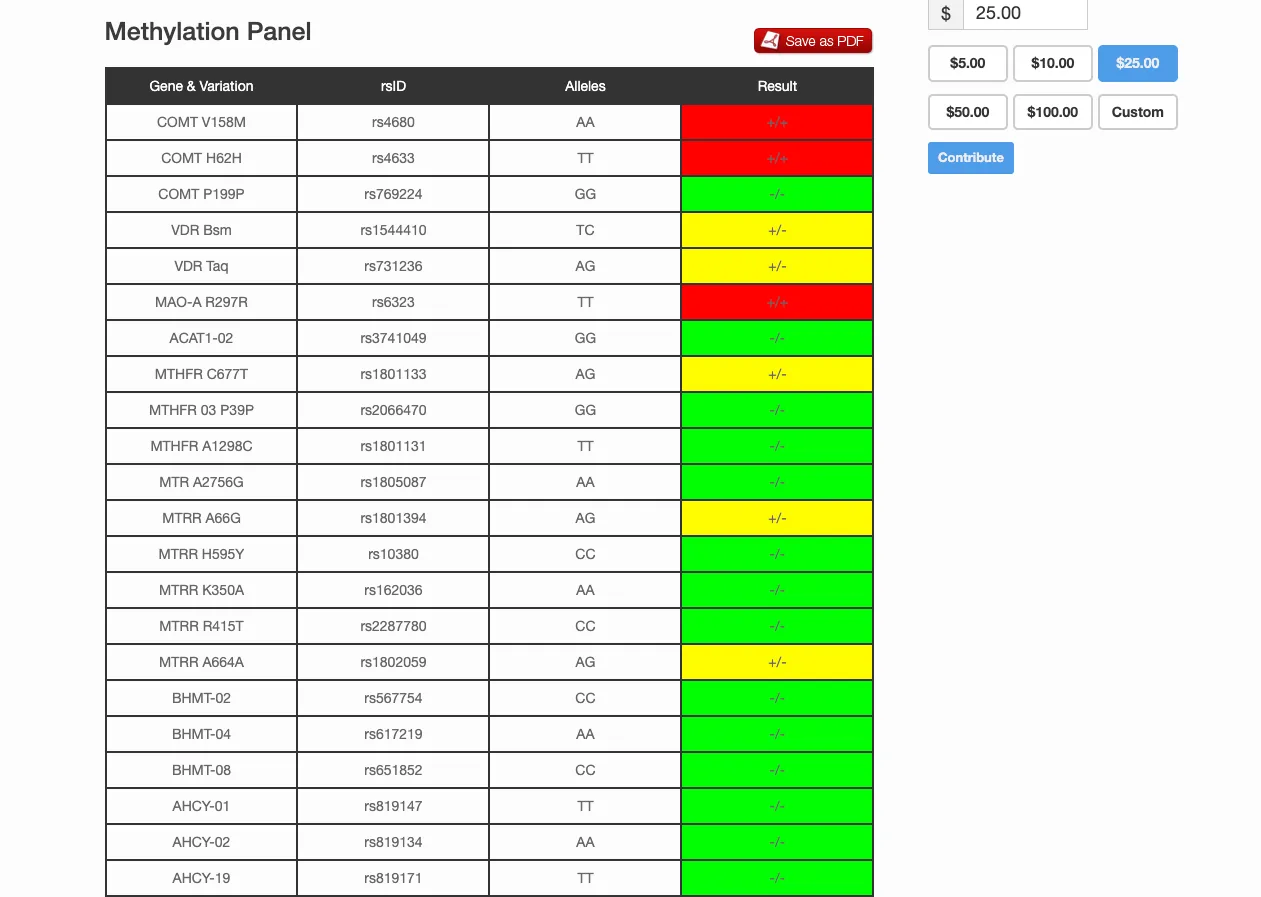
Available reports: a methylation panel, a detox panel and GenVue Discovery, a tool that looks up your variants in clinical databases such as ClinVar and also accepts whole genome and exome data.
Prices: free, whole genome included. You can donate if you like.
Bear in mind: it is a very technical platform, designed for people who already know about genetics. Its panels are tables with the gene, the variant, your genotype and a colour code, with no explanation of what each result means. Do not expect plain language: to get anything out of it you will have to research what each gene does on your own.
A good option for a free first exploration, if you are comfortable with technical information. The results are presented without interpretation.
Promethease
Promethease is a scientific literature search engine: it matches your file against SNPedia, a wiki of genetic variants, and gives you back what has been published about the ones you have. Since 2019 it has belonged to MyHeritage.
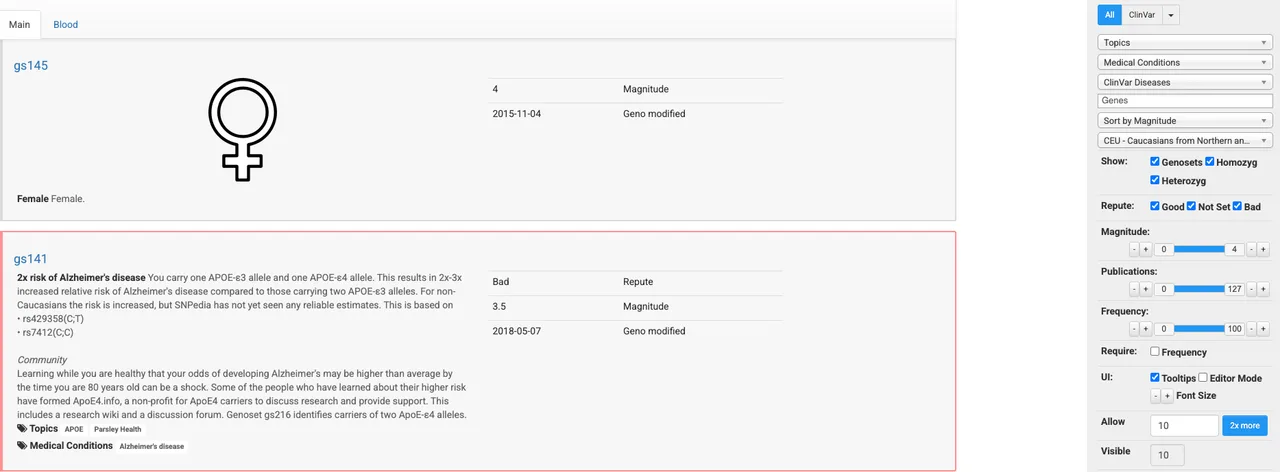
Available reports: a single report with every variant in your file that appears in SNPedia, covering traits, predispositions and drugs, with a link to each reference. It is a list you have to read yourself, without interpretation.
Prices: the report costs $25 and is ready in under 10 minutes. Adding another file to the same report costs $4 more. A whole genome costs the same, $25, although it takes longer.
Your data: since MyHeritage bought it, the data is transferred to and processed in the United States.
Bear in mind: it is a very technical platform. The report is an extremely long list of variants, with a relevance score, links to the studies and excerpts from the scientific literature as they were published. Do not expect plain language or a summary of what matters: it has a huge amount of depth, and sorting through it and interpreting it is up to you.
A good option if you have a whole genome, you are comfortable reading scientific literature and you want to go variant by variant.
How much you really get out of your file on each site
All six accept your genotyping RAW file. What changes is what they do with it, and what happens if what you have is the VCF of a whole genome:
- ADNTRO: with your genotyping RAW file or the VCF of your whole genome, ancestry, haplogroups, nutrition, fitness, personality and health research, all explained and with its study.
- Genomelink: ancestry and traits, with a new trait every week if you have the subscription. It accepts the VCF and charges the same.
- DNAGENICS: the deepest ancestry in the comparison, with ancient DNA and historical populations. With a VCF you pay for the conversion and keep only what a chip would read.
- GEDmatch: finding relatives and comparing ancestry calculators. It only works with genotyping files.
- Genetic Genie: free technical panels, and with your VCF, variant lookup in ClinVar.
- Promethease: a list of everything published about your variants. With a VCF the list is much longer, for the same price, and reading it is up to you.
Before uploading your DNA anywhere
Uploading your file is free on almost all of them. The difference lies in what the site does with it afterwards, and that is where most people get a surprise.
Your file is the ceiling of what any site can analyse. They can only work with the positions your original company’s chip read. That is why two people who upload their file to the same site can get different reports, depending on the chip each test was done with.
Before uploading it, ask four questions:
- Where is your data processed? Within the European Union you are protected by the GDPR. Outside it, it depends on each country’s law.
- Is your file visible to other users? Some sites compare it with other people’s to look for relatives. If you are not interested, check that you can switch it off. ADNTRO has no relative matching, so your file is not compared with anyone else’s.
- What happens if the company changes hands? Promethease went to MyHeritage in 2019 and its users were told their data was now with another company. Check what the privacy policy says for that case.
- Can you delete everything? Check that you can remove your file and your results whenever you want, with no questions asked. At ADNTRO you delete it yourself from your account, whenever you want, without having to ask anyone or go through customer support.
ADNTRO accepts files from other companies, processes them on European servers and tells you what can be analysed with yours before you pay anything.
Why choose ADNTRO?
This article was written by the ADNTRO team, so read it knowing that. We have tried to make up for it in the only way that seems serious to us: every figure in the table has been verified on each company’s website and you can go and check it, and when another site is a better option for a specific goal, we say so.
That said, these are the three reasons why we believe we are the most complete option for uploading your DNA:
- Your ancestry, and much more, in one place. 42 ethnic groups, your maternal and paternal haplogroups and your Neanderthal heritage, and with the same file nutrition, fitness, personality and health and medication research tools. More than 300 reports, and every result links to the study it is based on.
- We accept your genotyping file and your whole genome. Upload the RAW file from your company for free, or the VCF of a whole genome done by another company, such as TellmeGen, without having to convert it first.
- Your data stays in Europe. European servers under the GDPR, we do not sell or share your data, and you can delete it whenever you want.
And a warning that applies to all of them, us included: a consumer genetic report does not diagnose anything. It gives you information about predispositions and about how your body processes certain medicines. That information becomes valuable when you take it to your doctor. Never change a treatment on your own.
Genetics has an influence, but on its own it doesn't determine your health, your behavior, or your future.