
How hereditary is Alzheimer's disease?
How hereditary is Alzheimer's? Discover the different types of Alzheimer's that exist and how much genetics influences each one.
Updated on May 20, 2026
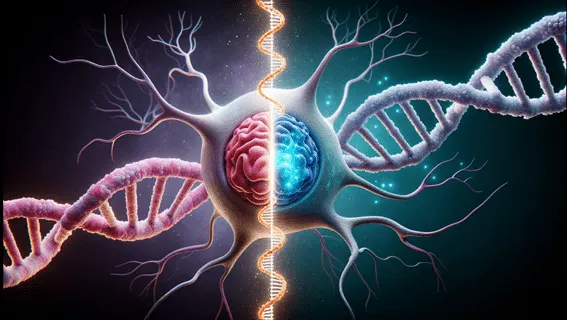
Alzheimer’s is a complex disease and its onset and progression are influenced by a combination of genetic (how hereditary Alzheimer’s is) and environmental (lifestyle) factors.
In terms of genetic architecture, we can classify Alzheimer’s disease into two main groups:
-
Hereditary early-onset Alzheimer’s disease:
- It is a rare form of the disease that usually affects people under 65 years of age.
- It accounts for less than 5% of all cases of Alzheimer’s disease.
- It has been related to mutations in three specific genes: PSEN1, PSEN2 and APP. The heritability of this type of Alzheimer’s disease is around 90%.
-
Late-onset Alzheimer’s disease:
- It is the most common form of the disease (about 95% of cases) and usually affects people over 65 years of age.
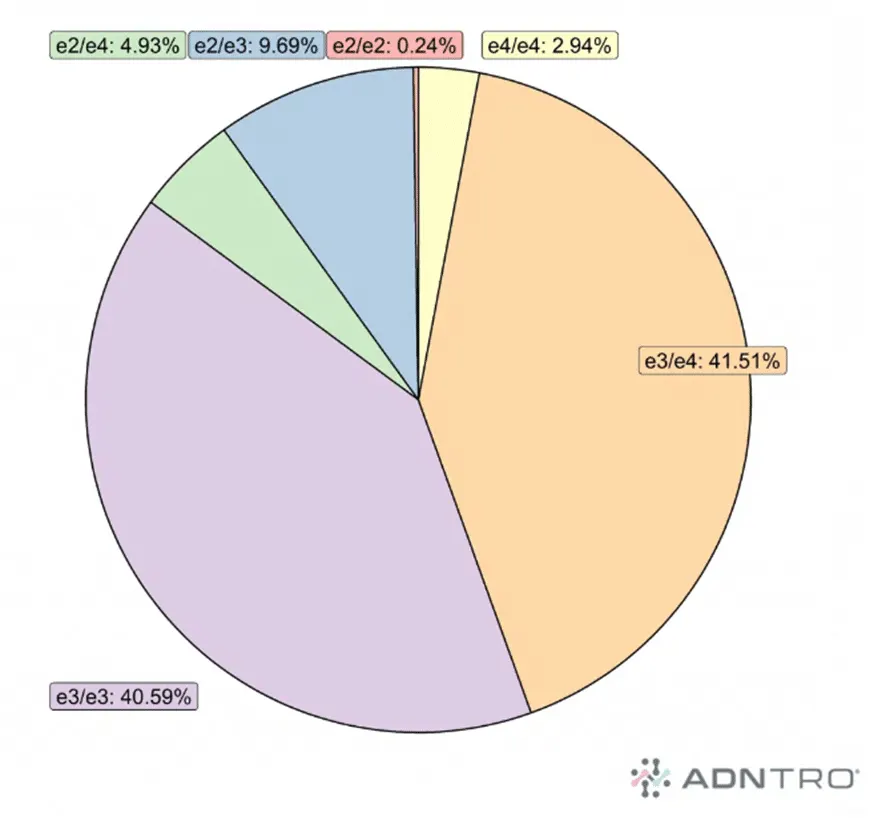
- Although the exact cause is not clear, several genetic variants associated with the disease have been identified (heritability around 70%). Among these variants, it can be found the ε4 combination of the APOE gene. People who inherit one copy of the ε4 form from one of their parents have an increased risk of developing Alzheimer’s, and those who inherit two copies (one from each parent) are even more at risk. However, having one or even two ε4 copies of the APOE gene does not guarantee that someone will develop Alzheimer’s disease. In the image below you will find the frequency of the different configurations of the APOE gene in European population (with and without Alzheimer’s). There are three configurations of the APOE gene (ε2, ε3, or ε4). Find out your APOE haplotype at ADNTRO!
It is important to note that although genetic factors may increase risk, they do not determine with certainty who will develop the disease. Many people with genetic risk factors never develop Alzheimer’s, while others without these factors do. Therefore, it is crucial to consider both genetic and non-genetic factors when assessing individual risk.
At ADNTRO we continue to investigate: towards a more accurate prediction of late-onset Alzheimer’s.
Genomic research is advancing rapidly, and at ADNTRO we are actively contributing to that progress. Our team has published a study in the scientific journal Genes titled Development of a k-Nearest Neighbors Model for the Prediction of Late-Onset Alzheimer’s Risk by Combining Polygenic Risk Scores and Phenotypic Variables, in which we developed a machine learning model capable of identifying people at risk of developing late-onset Alzheimer’s even before the first symptoms appear.
The model combines genetic information, APOE configuration, and readily available clinical variables such as age, cholesterol, or diabetes history, achieving a sensitivity of 80% —compared to the 63% of previous comparable models—, which represents a significant advance in the early detection of this disease.
It’s important to clarify that this research model, by incorporating clinical and personal data, has not been integrated into the ADNTRO platform, where we work exclusively with genetic information for privacy reasons. In your profile, we calculate your APOE configuration, one of the most determining markers in the risk of developing Alzheimer’s, and also relevant for evaluating the response to treatments such as lecanemab, recently approved by the European Commission.
Publishing this type of research reflects our commitment to science: we not only offer a genetic test, but we also contribute to building the tools of the future in predictive medicine.
Genetics has an influence, but on its own it doesn't determine your health, your behavior, or your future.