
Biological clock: what your biological age is and how it is measured
Your biological age says more about your health than your ID card. Find out how it is measured in your DNA methylation and what you can do to improve the result.

Two people aged 45. One sleeps well, trains and has flawless blood work. The other carries inflammation, insomnia and fifteen years of stress. Their ID cards say the same thing. Their bodies do not.
Your biological age is not the one on your ID card
Your chronological age counts the years since you were born. It is the age on your ID card, on your insurance, on the candles of your birthday cake. It is an administrative figure and it says nothing about how your body works inside.
Your biological age measures the real state of your cells: how they repair themselves and how your genes are expressed. It is the real pace at which you are ageing, not the time that has passed.
Two people aged 45 can have bodies that work as if they were 38 or 54. Same date of birth, two different paces.
The key difference: biological age does move.
What the biological clock is and where it is written
The biological clock is the mechanism that sets that pace. And it is written chemically on your DNA.
Your DNA is the same in all your cells and its letters never change. What changes is which genes are read, and how much. That is what epigenetics deals with.
The best-studied mechanism is DNA methylation: methyl groups added at specific positions called CpG sites, points where a cytosine is followed by a guanine. Over the years those positions accumulate methyl, like dust settling on a mechanism, and the gene becomes increasingly silenced.
The process is gradual, predictable and measurable. That is why it can be read like a clock.
How many epigenetic clocks are there?
More than a hundred have been published, and each one answers a different question.
| Type | Examples | What it answers |
|---|---|---|
| Chronological age | Horvath (2013), Hannum (2013) | How old do your cells look? |
| Health and mortality | PhenoAge (2018), GrimAge (2019) | What risk do they reflect? |
| Pace of ageing | DunedinPACE (2022) | How fast are you ageing right now? |
| Single-gene targeted | AgingMETRIX (ELOVL2) | What is your biological age? |
That the field is this alive is good news. We have chosen the path of one specific marker, heavily studied and very stable.
ELOVL2: 20,000 genes, one knows how you age
Of the more than 20,000 human genes, one stands out as a molecular stopwatch.
ELOVL2, on chromosome 6p24.2, turns omega-3 DHA into very-long-chain fatty acids that protect the membranes of your retina, your brain, your heart and your muscle. As you age, methylation gradually silences this gene, and with it your body’s ability to make those essential lipids.
That decline is so consistent and so measurable that it makes ELOVL2 one of the best age markers there is.
The AgingMETRIX model, developed by EpiDisease S.L., works on it, and it is the one we use at ADNTRO:
- From a saliva sample: ELOVL2 methylation is measured on the DNA extracted from it, with no blood draw and no visit to a clinic.
- Validated in more than 4,600 people from four continents: Asia, Europe, America and Africa.
- Sex-specific models, different for men and for women, because the methylation pattern does not age the same way.
- Less than 5% technical variability in most of the CpG sites analysed. This matters: if you are going to repeat the test in six months, you need the measurement to be stable enough to compare.
- Mean accuracy (MAE) of ±4.5 years, in line with the leading reference epigenetic clocks. Differences below that range are noise; above it, signal.
New: your biological clock, now at ADNTRO
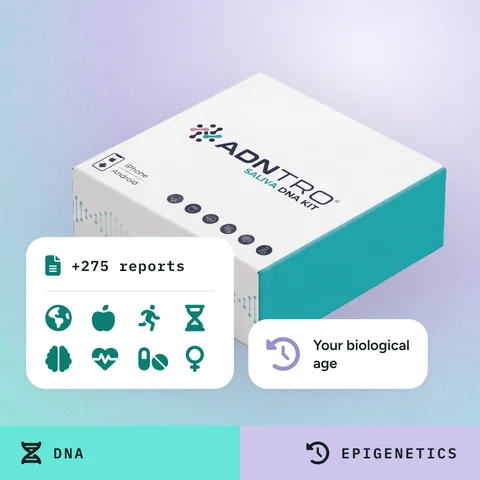
We are launching the Complete Pack: your biological clock together with your ADNTRO Premium genetic test, on the same platform.
- ⏳ Your biological age with the AgingMETRIX model on ELOVL2 methylation, from a saliva sample.
- 🧬 Your whole genetic profile: ancestry, nutrition, fitness, personality and prevention.
- 🔗 Cross-reading: your clock interpreted against your genetics, not two separate reports.
- 📈 Tracking table to record each measurement and see how it evolves.
👉 Buy the genetic test + biological clock
Why your biological clock delivers more alongside your genetics
Your biological clock gives you a number: you function like someone of 52 and you are 46. Measured and useful. So what now? The recommendation that comes with almost all of these reports is identical for everyone.
Your genetics is what turns that generic advice into a plan of your own: which metabolic pathways to watch in your case, which nutrients you need more of, which type of training you respond to best.
One is the map, the other the GPS. And there is a practical advantage: DNA is analysed once in a lifetime. The biological clock is repeated, on a base you never pay for again.
What to do with the result
If your clock runs ahead of your age, it is not a diagnosis. It is a warning with room to manoeuvre, because epigenetics is plastic.
- Exercise. 150 minutes of moderate activity a week; walking counts. Sixteen weeks of supervised exercise were enough to reduce ELOVL2 methylation in a clinical trial.
- Sleep. 7–9 hours on a steady schedule. Deprivation speeds up the clock measurably.
- Diet. More leafy greens, fewer ultra-processed foods.
- Chronic stress. It directly alters methylation patterns.
- Tobacco. The biggest known accelerator.
An intensive eight-week protocol combining diet, sleep, exercise and probiotics achieved an average reduction of 4.6 years of biological age. These are small studies and the direction is promising, but nobody can promise you a specific rejuvenation figure.
The reasonable horizon for measuring again is six months. With any less, you cannot tell a real change from noise.
Frequently asked questions
What is biological age? An estimate of the real functional state of your cells, as opposed to chronological age, which only counts years. It can be higher or lower than the one on your ID card and it changes with your habits.
How is the biological clock measured? With an epigenetic test from saliva. The degree of methylation at the key CpG sites of the ELOVL2 gene is measured, and the AgingMETRIX model translates that pattern into an age.
What is ELOVL2 and why that gene? A gene on chromosome 6 involved in omega-3 metabolism. Its methylation increases with age in a particularly consistent way, which makes it one of the most reliable biological age markers.
How is it different from a genetic test? A genetic test reads your DNA sequence, which never changes. The biological clock reads chemical marks on that DNA, which do change with lifestyle, and that is why it can be repeated.
How often should it be repeated? Every six months. That is how long a change of habits needs to leave a measurable mark on your DNA.
I already have the ADNTRO genetic test, can I buy just the biological clock? Yes, you can buy the biological clock on its own if you have already taken your DNA test with us.
Is it a medical diagnosis? No. It is guidance about your cellular health, it reflects the moment the sample was taken and it does not replace assessment by a healthcare professional.
Genetics has an influence, but on its own it doesn't determine your health, your behavior, or your future.
References
- Cheishvili et al., 2025
- Garagnani et al., 2022
- Moulton et al., 2024
- Fitzgerald et al., 2023