
Beta-oxidation of fatty acids
Beta oxidation is a metabolic process in which fatty acids are degraded for energy.
Updated on July 28, 2025
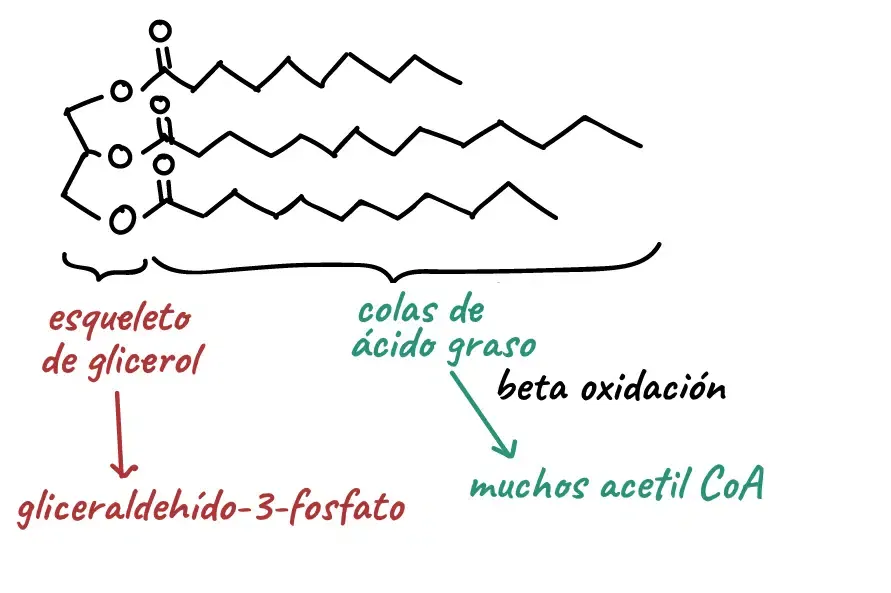
Upon completion of the lipolysis, the fatty acids generated enter the bloodstream to be used by our organism in a process known as beta-oxidation. This process occurs mainly in the mitochondria of cells such as those of skeletal muscle and the heart.
Transport of fatty acids to the mitochondria
So, how do the fatty acids reach the mitochondria?
- They travel through the bloodstream: Due to their hydrophobic nature, fatty acids cannot move freely through the bloodstream. They must always go hand in hand with albumin, a protein that acts as a transport for fatty acids.
- They enter the cell: Thanks to fatty acid transporters, fatty acids pass from the bloodstream into the cell cytoplasm where they are activated and then enter the mitochondria.
- They are activated: Once in the cytoplasm, the fatty acids must be activated in order to enter the mitochondria. This process is called activation of fatty acids and consists of the bonding of a fatty acid to a coenzyme A (CoA) molecule, forming a acyl-CoA. This step is catalyzed by the enzyme acyl-CoA synthetase and requires energy in the form of ATP.
- **They enter the mitochondria through the Carnitine Shuttle.**To enter the mitochondria, the already activated fatty acids (acyl-CoA) require a carrier molecule called carnitine.
Beta-oxidation of fatty acids
Once the fatty acids reach the mitochondrial matrix, fatty acid beta-oxidation begins, a metabolic pathway in which fatty acids are broken down into two-carbon units to generate acetyl-CoA and produce energy.
The molecules of acetyl-CoA can subsequently enter the Krebs cycle for additional energy production in the form of ATP. In addition to acetyl-CoA, beta-oxidation produces NADH and FADH₂ molecules that transport electrons to the electron transport chain to produce even more ATP.
Beta-oxidation consists of a cyclic series of reactions that, each cycle, shortens the fatty acid chain by two carbons producing:
- Acetyl-CoA: Enter the Krebs cycle to generate even more ATP (penultimate step of the aerobic cellular respiration).
- NADH and FADH₂: Electron transporters that carry energy to the electron transport chain to produce ATP.
For a long-chain fatty acid, this process can be repeated many times, generating large amounts of ATP. For example, beta-oxidation of a 16-carbon fatty acid (such as palmitic acid) produces 8 molecules of acetyl-CoA, 7 NADH and 7 FADH₂.
Genetics has an influence, but on its own it doesn't determine your health, your behavior, or your future.