
Do you know what DNA is and its functions and structure?
In this article you will learn about the importance of DNA, the main functions it performs, and delve into its structure.
Updated on July 10, 2026
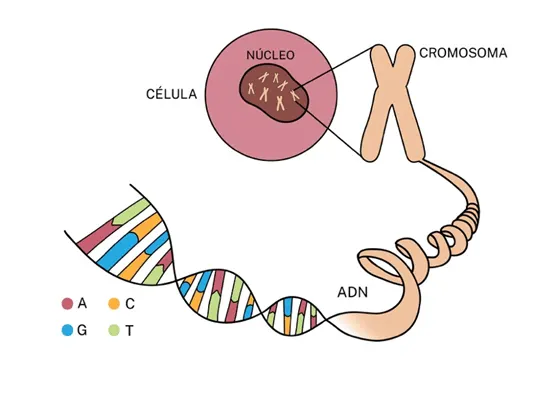
DNA stands for deoxyribonucleic acid, the molecule that holds the instructions to build and run a living being. It sits in the nucleus of almost every one of your cells, it is shaped like a double helix and it is written with four letters — A, C, G and T — repeated along more than 3 billion base pairs. Its function is threefold: to store that information, to copy it so that it passes to the next generation and to dictate how proteins are made. In this article we will look at what DNA is, what it does and how it is built.
What does DNA stand for?
DNA stands for deoxyribonucleic acid. The “deoxyribo” part comes from the sugar that forms its backbone, deoxyribose, and “nucleic” recalls the nucleus of the cell, which is where it was first found. In Spanish and other Romance languages it is written ADN, with the words in the opposite order.
What is DNA for?
DNA is essential for life and its proper functioning, as it is responsible for the transmission and regulation of genetic information and the synthesis of proteins.
It mainly stores genetic information, information that makes us who we are and makes it possible for us to be alive. It is responsible for synthesizing the functional units of our body (proteins) and regulating the expression of genes.
It also serves as the primary unit of inheritance in all living beings. In other words, every time an organism reproduces, a portion of its DNA is passed on to its offspring. This total or partial transmission of an organism’s DNA helps ensure a certain level of continuity from one generation to the next, while allowing slightly changes that contribute to the diversity of life, the adaptation of species, and their evolution.
What is the structure of DNA?
And you may wonder, how is it possible that a cell (not visible for the human eye) can storage more than 3,000 million letters that are equivalent to 2 meters in length?
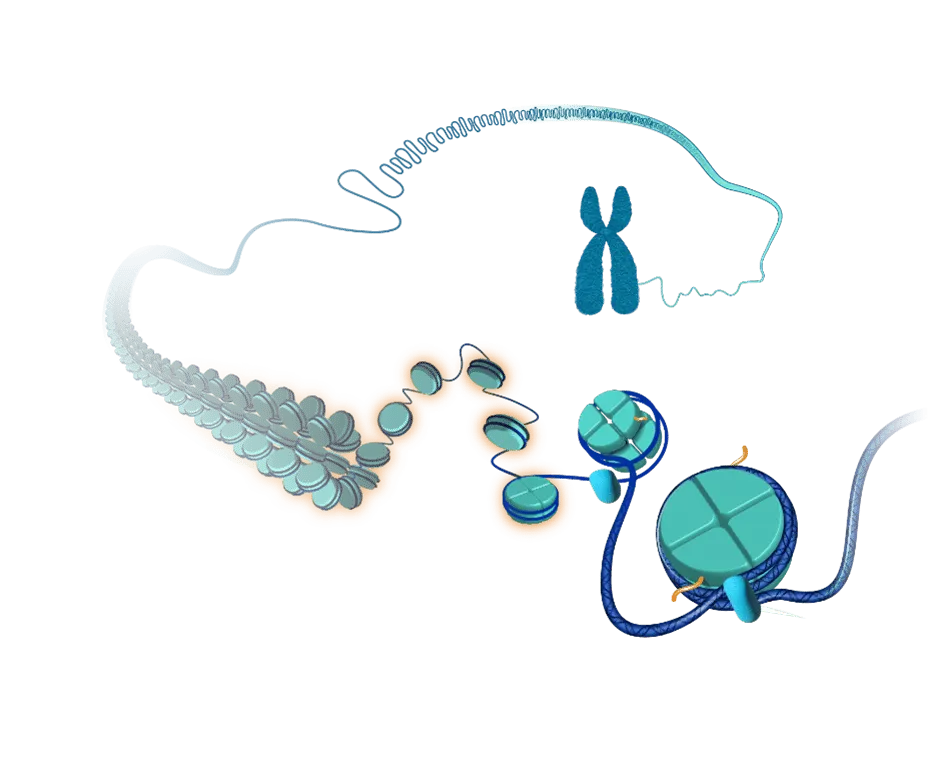
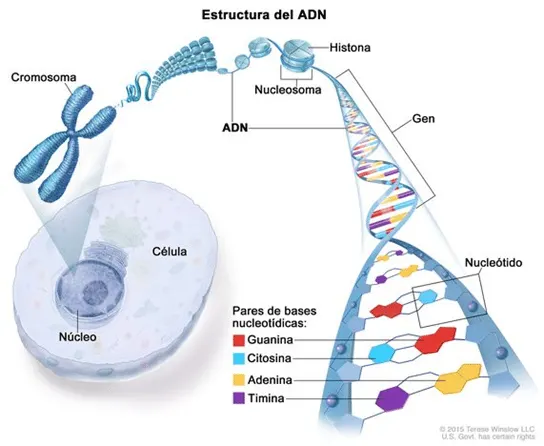
This is possible thanks to the compaction in which DNA and its complex structure are found. DNA consists of different levels of condensation being de lower to higher:
Nucleotide
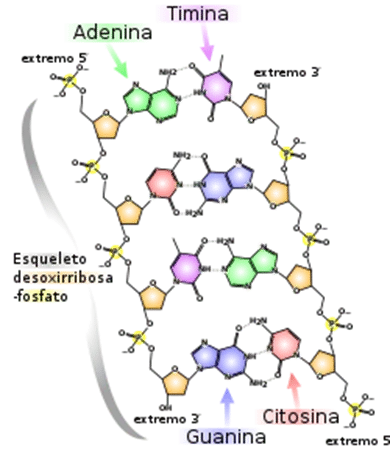
DNA is composed of a linear sequence of nucleotides, which are the structural units of the DNA molecule. Each nucleotide is composed of a nitrogenous base, a phosphate group and a five-carbon sugar (deoxyribose). The nitrogenous base can be adenine (A), thymine (T), cytosine (C) or guanine (G).
DNA double helix
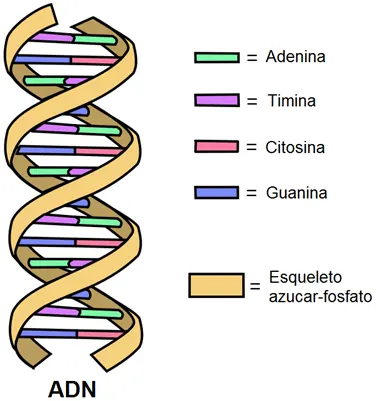
The DNA molecule is a double helix, in which two strands of nucleotides are wound together to form a spiral structure. The two strands of DNA are linked by hydrogen bonds between complementary nitrogenous bases. Each strand of a DNA molecule is composed of a long strand of nucleotide monomers.
This helix structure is fundamental for the replication and function of DNA.
Nucleosome
The DNA molecule is organized into nucleosomes thanks to histones. Histones are essential proteins for maintaining the structure of DNA which in turn facilitates its accessibility to regulatory factors and the transcription and replication machinery. Due to their positive charge they are able to compact DNA (negative charge). Each nucleosome contains approximately 147 base pairs of DNA and several proteins.
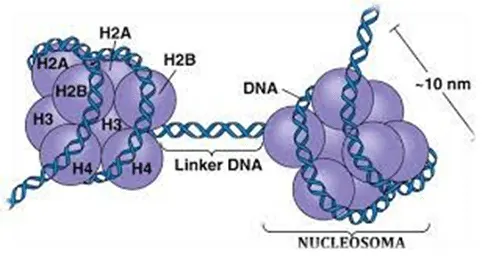
Chromatin
Chromatin is the form in which DNA is found in the eukaryotic cell (coiled nucleosomes). Chromatin is composed of a combination of DNA and chromosomal proteins, especially histones, that keep DNA in a compact structure accessible for genetic regulation. Chromatin is a condensed material found in the nucleus of the cell for most of the cell cycle.
It is a condensed and dynamic material that is composed of DNA and chromosomal proteins and plays a key role in the regulation of gene expression and in the equitable distribution of DNA during cell division.
Chromosome
During cell division, chromatin condenses to form chromosomes during cell division, allowing for the equal separation and distribution of DNA to daughter cells.
These are long, elongated structures that can be visualized with an optical microscope during a very specific point of the cell cyclecell division.
What is the function of DNA?
DNA is essential for life and its proper functioning. Among its main functions, the following stand out:
- Genetic Information StorageDNA contains the genetic information that defines us and allows us to live.
- Protein SynthesisDNA directs the synthesis of proteins, the functional units of our body.
- HeritageDNA acts as the primary unit of heredity in all living things, transmitting genetic information from one generation to the next.
- Gene RegulationDNA regulates gene expression, ensuring that proteins are produced in the right amounts and at the right time.
Conclusion
DNA is a fundamental molecule for life. Its complex structure allows it to store and transmit the genetic information necessary for the development and functioning of all living organisms. Understand what is DNAits structure, parts and functions is essential to understand the biological processes that allow us to exist.
Do you want to know the secrets hidden in your DNA? 👀 Don’t wait any longer, use the code. BLOG10 on your purchase and enjoy a discount of 10%. Embark on the journey to self-knowledge with the genetic test of ADNTRO or by upload your RAW DNA data!
Genetics has an influence, but on its own it doesn't determine your health, your behavior, or your future.